A small courtyard can look simple to water, until pots, paving, and narrow planting beds create awkward corners. A useful Courtyard Sprinkler should reach those spaces without soaking a bench or sending water across the path. That balance matters. It can be easy to overlook.
The U.S. EPA WaterSense program reports that landscape irrigation uses more than 9 billion gallons of water daily in the United States. It also notes that as much as half may be lost through evaporation, wind, or runoff. Those figures make coverage and adjustment more than minor shopping details. For a compact garden, a sprinkler with a controllable spray pattern may help reduce overspray, though results depend on placement, pressure, and local conditions.
This Top 10 guide compares options for small outdoor spaces, focusing on coverage control, ease of setup, durability, and suitability for beds or containers. Product specifications and manufacturer claims can help narrow the choices, but they do not replace a real fit check. Measure the courtyard, note nearby walls, and consider where water tends to pool. A model that works well on an open lawn may frustrate you between brick borders and leafy pots. These picks are a starting point, not a promise of perfect watering. Watering needs vary. EPA WaterSense guidance offers a reliable reminder: use water thoughtfully, and adjust irrigation to the site.
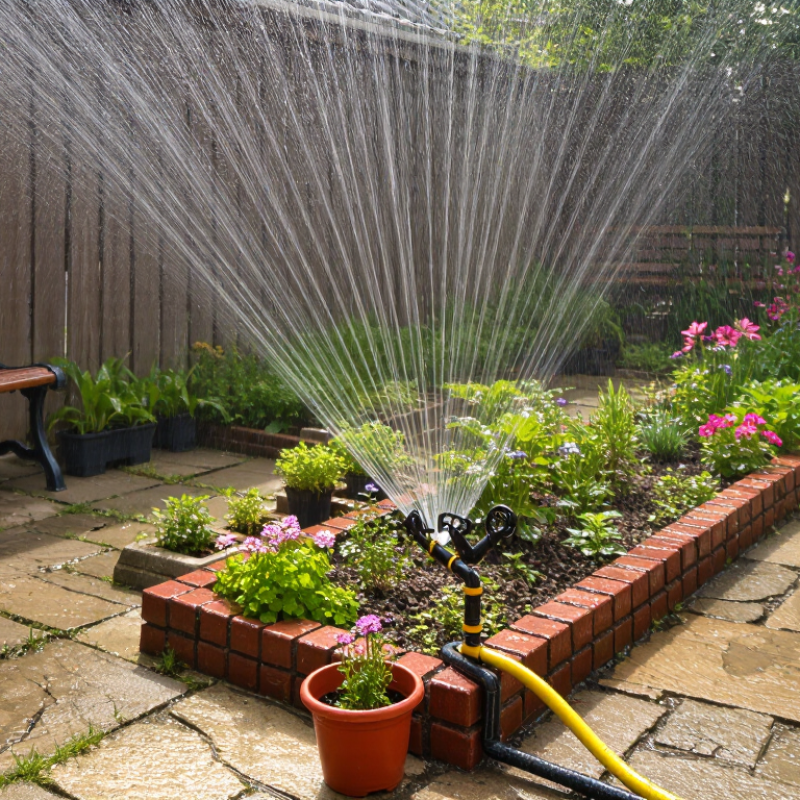
In a small courtyard, a sprinkler works by converting water pressure into a moving spray or rotating stream. Nozzles shape the coverage, while the sprinkler’s position and flow determine where water lands. A compact oscillating head may cover a rectangle; a rotary or stationary head can suit a narrow bed. Walls and paving change the pattern. Small spaces amplify errors.
Set a few straight-sided catch cups across the garden and run the sprinkler for 10 minutes. Compare the water depth in each cup. Uneven levels suggest adjusting the position, spray angle, or run time. A neat spray pattern is not proof of even watering. That assumption is easy to make—and easy to get wrong. EPA WaterSense reports that outdoor use accounts for more than 30 percent of household water use in the United States, and can reach 60 percent in arid regions. Its guidance also notes that much outdoor water is lost through evaporation, wind, and runoff. EPA WaterSense, “Outdoor Water Use.” Keep spray off courtyard walls and paving, and water when wind is low. Check the soil beneath the surface, too; a damp top layer can hide dry roots. Small adjustments matter.
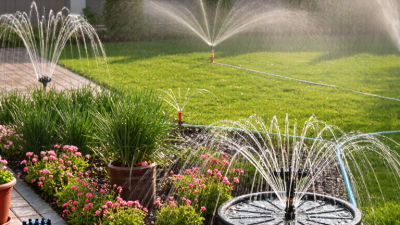
Fixed-spray sprinklers suit compact beds and tight corners, but their fine spray can drift in wind. Rotary nozzles send thicker streams over a wider area and usually apply water more slowly. Oscillating sprinklers cover rectangular patches, though walls and pots can block their paths. There is no perfect head.
Match the sprinkler pattern to the courtyard’s shape, then check the maker’s coverage chart before buying. EPA WaterSense reports that landscape irrigation uses nearly 9 billion gallons of water daily in the United States, and up to 50 percent may be wasted through evaporation, overwatering, or poor system design. That national figure is not a courtyard estimate, but it shows why placement matters. Set containers aside, run each sprinkler briefly, and look for dry soil near bed edges or puddles beside paving. Small spaces still have uneven spots.
Tips: Place several shallow, straight-sided cans around the garden. Run the sprinkler for ten minutes, then compare water depth. Uneven results? Adjust the arc or move the head. I would recheck after plants fill out; coverage changes.
Coverage figures are approximate and depend on water pressure, nozzle settings, wind, and garden layout. Choose an adjustable pattern and test the spray before setting a watering schedule.
| Rank | Sprinkler Type | Typical Courtyard Coverage | Spray Pattern | Best Use in a Small Garden | Practical Consideration |
|---|---|---|---|---|---|
| 1 | Adjustable stationary sprinkler | About 150–500 sq ft; roughly a 7–13 ft radius when set to a full circle | Adjustable circle, partial circle, or multi-directional spray | Compact lawns and mixed planting areas where the spray needs to avoid walls or paths | Simple to position and adjust; check that the chosen pattern does not overspray paved areas. |
| 2 | Compact oscillating sprinkler | About 300–1,200 sq ft, depending on the adjustable width and reach | Rectangular fan of moving water streams | Long, narrow courtyards or rectangular lawn strips | Adjust the range and width for the space; wind can move the spray beyond the intended edges. |
| 3 | Rotary multi-stream sprinkler | About 200–700 sq ft; commonly an 8–15 ft radius | Rotating streams that cover a circle or selected arc | Irregular garden shapes and beds that need a controlled arc | Rotating streams can provide a more controlled application than a broad, fine spray in light wind. |
| 4 | Mini gear-drive rotor | About 500–1,500 sq ft; often a 13–22 ft radius at suitable pressure | Rotating stream with adjustable arc and distance | Open courtyard lawns where one sprinkler should reach across a larger area | May be too powerful or too large for a very small space; confirm the minimum radius before choosing. |
| 5 | Mini impact sprinkler | About 500–1,500 sq ft; commonly a 13–22 ft radius | Intermittent rotating jet with adjustable arc | Open areas with few delicate plants near the spray path | Usually audible while operating, and its stronger jets may disturb light soil or small seedlings. |
| 6 | Micro-sprinkler | About 30–300 sq ft per head; roughly a 3–10 ft radius | Fine spray or small rotating pattern | Raised beds, densely planted borders, and small groups of plants | Useful for targeted coverage; small outlets can clog and may need occasional cleaning. |
| 7 | Pop-up spray head | About 100–400 sq ft per head; roughly a 5–11 ft radius | Fixed spray with interchangeable or adjustable arc nozzles | Permanent courtyard irrigation where heads can be placed around a lawn or planting bed | Requires an installed irrigation line; adjacent heads may need to overlap for even coverage. |
| 8 | Low-angle shrub sprinkler | About 100–350 sq ft; roughly a 5–10 ft radius | Low, directed fan or partial-circle spray | Low borders and beds where nearby walls or foliage make high spray patterns unsuitable | Keep the spray unobstructed and check that taller plants do not block water from reaching the soil. |
| 9 | Spike-mounted rotary sprinkler | About 200–700 sq ft; roughly an 8–15 ft radius | Rotating circle or adjustable arc | Temporary watering in a small lawn or open courtyard bed | The spike is easy to reposition, but it should be set firmly in the ground to prevent movement. |
| 10 | Square-pattern stationary sprinkler | About 100–350 sq ft; often a square area around 10–19 ft across | Several fixed streams arranged in a square or rectangular pattern | Small, regular-shaped lawns and courtyards with clear boundaries | Check for dry spots between streams and reposition the unit if the garden shape is uneven. |
A courtyard sprinkler should match the shape of your garden, not just its total area. For a narrow bed beside a patio, an adjustable arc can prevent water from soaking chairs or walls. Check whether the spray reaches corners without leaving dry strips. A rotating head may cover more ground, while a fixed pattern can suit a small, regular lawn. Coverage charts are useful, but real results change with water pressure and wind.
Tips: Test the sprinkler for five minutes before leaving it unattended. Place a few shallow cups around the garden and compare the water levels. This quick check reveals uneven coverage. Also inspect the connector and hose fit; a small leak can waste water and reduce spray distance. Keep the test simple.
Look for stable feet or a base that stays put on paving and soil. Easy-to-adjust controls matter when garden beds change through the season. A filter can help keep grit from blocking small nozzles, though it still needs occasional cleaning. Durable plastic is often lighter to move, but may feel less steady in strong water flow. No option is perfect. Consider storage space, too: a compact model is easier to tuck beside a shed, even if its spray range is modest.
A courtyard needs controlled coverage, not a sprinkler designed for a broad lawn. Small spaces punish waste. The most useful choices include compact oscillating, rotating, stationary multi-pattern, circular, and square-pattern sprinklers. Oscillating models suit narrow beds, while rotating heads can cover open central patches. Stationary models are simple, but their spray may miss corners. Check the stated coverage area against your actual garden dimensions.
Other useful options include spike-mounted, stable-base, low-pressure, fine-spray, and adjustable-arc sprinklers. Spike-mounted designs fit soft soil; base-mounted units are easier to move across paving. Low-pressure models may help where water flow is modest, though results depend on your plumbing. Fine spray can be gentle on seedlings, but wind may carry it onto walls. Adjustable arcs help keep water away from doors and seating.
Before choosing, measure the courtyard and note nearby pots, walls, and drains. A short watering test reveals dry strips and unwanted overspray. Not every “small garden” has the same shape, and product coverage figures can be optimistic. I would leave room to reposition the sprinkler; that extra step is slightly inconvenient, but often prevents soaked paving and thirsty corners.
A courtyard sprinkler should wet the soil, not the paving stones. Place it on level ground, then test its spray before fixing the layout. Adjust the arc so water reaches the edges without soaking walls or doorways. Check the water pressure and follow the sprinkler’s installation instructions; uneven pressure can leave dry patches. Small details matter. The U.S. EPA’s WaterSense outdoor-water guidance says as much as 50% of water used outdoors can be lost through evaporation, wind, runoff, or inefficient irrigation. A careful test run helps reduce waste.
Tips: Run the sprinkler early in the morning, when wind and evaporation are often lower. Set out a few shallow cups to compare how much water reaches different corners. It is a simple check, but easy to skip.
Clean the filter and spray openings monthly, especially after dusty weather. A soft brush can remove grit without damaging the nozzles. Watch for puddles, weak spray, or water hitting the courtyard wall; each may signal a blockage or poor alignment. Adjust the timer as seasons change, and drain the system before freezing weather. I would not assume one schedule works all year. Keep a short watering log for a few weeks, then revise it when the soil stays wet or plants begin to droop.